

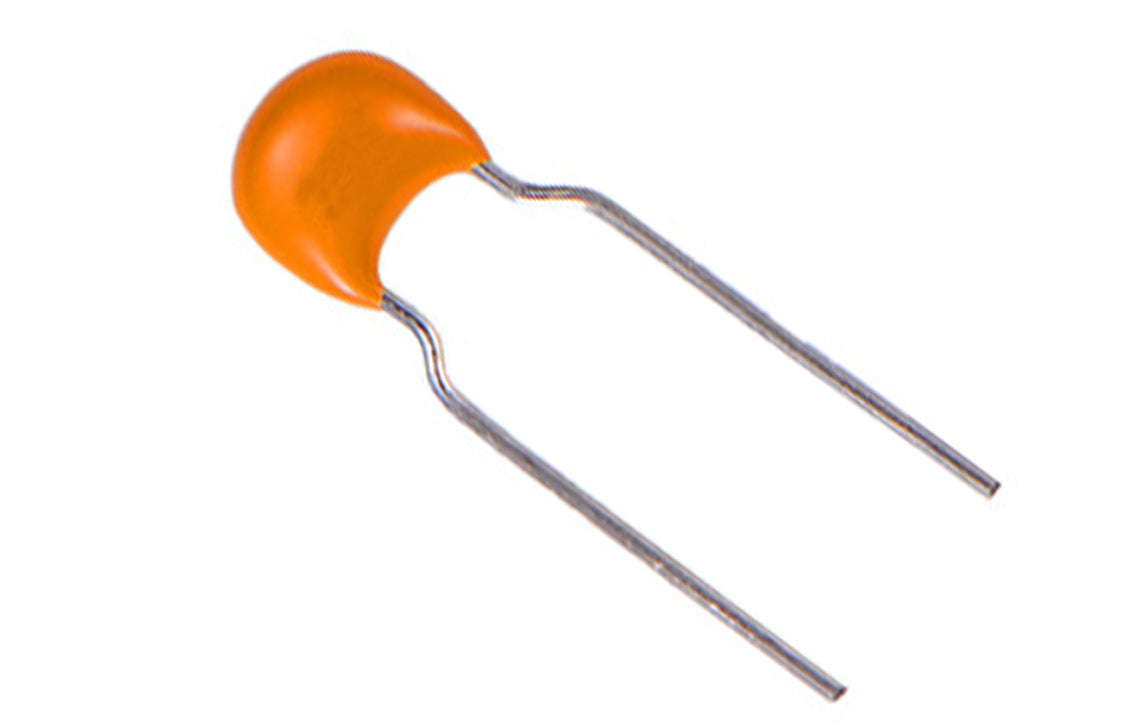
When you dive into the world of DIY electronics, you will quickly notice small, bead-like components scattered across almost every circuit board. These are multilayer ceramic capacitors. While they might look like tiny, colored drops of epoxy with two metal legs, they play a massive role in keeping your hardware running smoothly.

Section 1: Overview & How It Works
Think of a ceramic capacitor as a temporary, lightning-fast storage tank for electricity. Inside its small protective shell, multiple alternating layers of metal and ceramic materials are stacked closely together. The metal layers act as conductors that hold an electrical charge, while the ceramic layers act as an insulator, preventing the electricity from jumping directly between the plates.
Unlike large batteries that store massive amounts of energy and release it slowly, ceramic capacitors handle tiny amounts of energy and can charge or discharge in a fraction of a millisecond. Their primary job in electronics is to absorb quick voltage spikes and fill in brief electrical dips. They act as steadying anchors, smoothing out electrical noise and keeping power lines remarkably stable across an operating temperature range as wide as -55°C to +125°C.
Section 2: Real-World Use in Arduino Projects
If you are a maker building your first interactive gadget, ceramic capacitors are essential for protecting sensitive microcontrollers. When a motor turns on or a relay clicks, they draw sudden bursts of current that create electrical interference. Adding a ceramic capacitor across your power lines absorbs this chaos, ensuring your hardware reads sensors accurately without crashing or resetting unexpectedly.
These tiny components are perfect for hands-on soldering practice. Because they have no polarity—meaning there is no positive or negative leg—you can solder them into a circuit board in either direction without worrying about damaging the part. This makes them incredibly forgiving to use in any introductory soldering practice kit.
Here are two classic ways a hobbyist can use ceramic capacitors in a typical project:
- Button Debouncing: When you press a mechanical pushbutton, the metal contacts inside physically bounce, causing an Arduino to think you pressed it multiple times. Placing a ceramic capacitor across the switch absorbs these microscopic electrical bounces, giving you a clean signal every single time.
- Power Supply Decoupling: When assembling an electronics kit, soldering a ceramic capacitor right next to the power pins of a microchip acts as a local reservoir, feeding the chip instant energy whenever it processes heavy tasks.
See It in the Testudo Kit
Every component in this guide is part of the Testudo soldering practice kit — a hands-on way to learn electronics, soldering, and Arduino coding from the ground up.


