

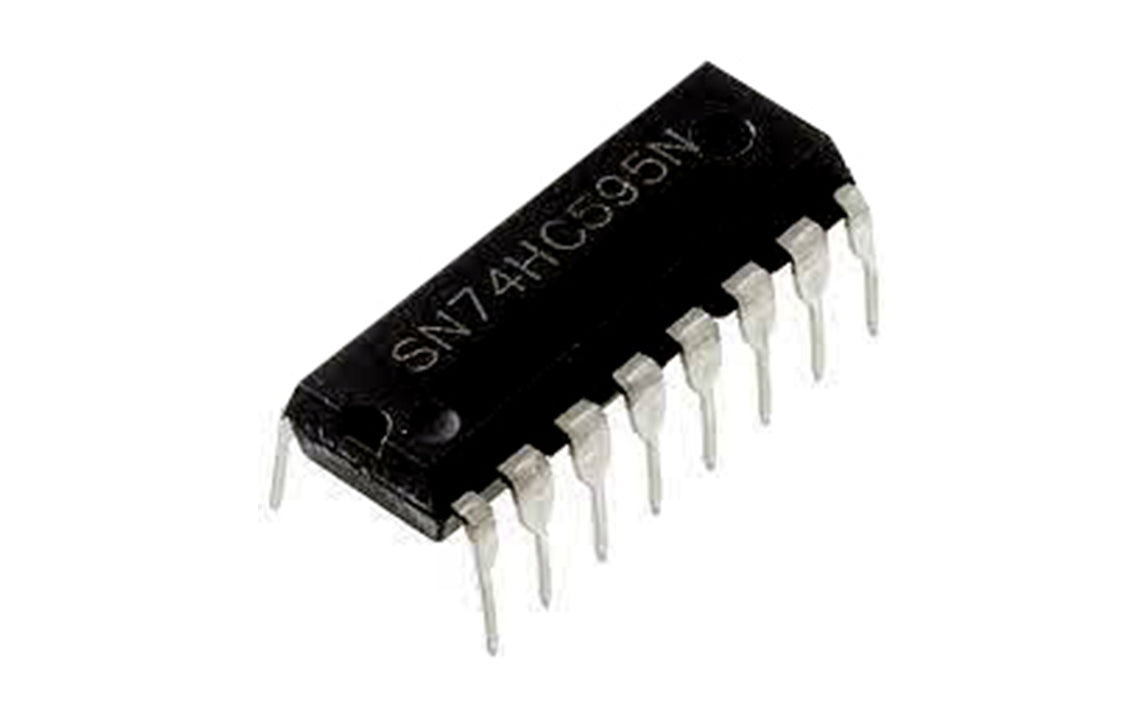
Section 1: Overview & How It Works
Have you ever run out of input or output pins while building an electronics project? This common roadblock is exactly where the shift register comes to the rescue. It acts as an IO expander, allowing you to control multiple peripheral lines using just a tiny handful of connections from your main board.

Essentially, a shift register takes a rapid stream of data arriving one bit after another—known as serial data—and spreads it out into multiple parallel pathways simultaneously. Think of it like a train conductor directing a single-file line of passengers into eight different individual cabins at the exact same moment.
Inside this integrated circuit, an internal memory bank captures and holds data for extended periods. When the clock signal pulses, each piece of data advances to the next position in line. Once all the data bits are correctly positioned, an internal storage register locks them in, enabling the chip to cleanly present the active high or low voltage output to all your connected components at once.
Section 2: Real-World Use in Arduino Projects
For any avid maker tinkering with the Arduino ecosystem, the shift register is a staple component. Microcontrollers are powerful, but they have a physical limitation on how many components they can directly plug into. By mastering how to wire a shift register during your next soldering practice session, you unlock the ability to manage massive displays and complex arrays without upgrading to a more expensive development board.
When building a DIY soldering practice kit, integrating a shift register opens up several classic beginner-friendly projects:
- Massive LED Animations: Instead of sacrificing eight valuable digital pins on your board to drive eight individual LEDs, you can use a shift register to drive them all using only three pins. This setup makes it incredibly simple to create multi-LED running light displays, persistence-of-vision wands, or complex visual countdown patterns.
- Driving 7-Segment Displays: If you want to build a digital clock or a scoreboard tracker, controlling a multi-digit 7-segment display manually will quickly exhaust your available pin count. A shift register simplifies this challenge by cleanly converting your basic serial instruction stream into the parallel signals needed to illuminate the individual numerical segments.
Adding this component to your hobby repertoire expands your design horizons, shifting your focus from worrying about hardware limitations to designing intricate, creative coding sequences in your IDE.
See It in the Testudo Kit
Every component in this guide is part of the Testudo soldering practice kit — a hands-on way to learn electronics, soldering, and Arduino coding from the ground up.


